Hot and cold spots
Duct modifications for hot and cold spots in Yakima Valley homes
Annoying hot and cold spots usually trace back to the ducts. We find the inefficiency and plan the fix, from a new return to a rebuilt run.
Chapter 01
Why one room runs hot while the next one is fine
A house that reads 72 on the thermostat and 82 in the upstairs flex room does not have a thermostat problem. It has an airflow problem, and the airflow lives in the ducts. The furnace or A/C is making plenty of heat or cooling. Some of it is just never arriving where you live.
In Yakima Valley houses the cause is usually one of a short list: a room with no return path, so the air has nowhere to go back to the system; a run that sits at the far end of the plenum and gets what is left over; a duct that leaks into an attic or crawl space; a flex run that got crushed or kinked during a remodel; or a layout that was fine for the house as first built and never adjusted after an addition. Our summer afternoons run hot and our winter mornings run cold, so a weak room shows itself twice a year.
None of that is fixed by turning the thermostat up or down, and most of it is not fixed by buying bigger equipment either. It is fixed by finding where the air is going wrong and changing that one thing.
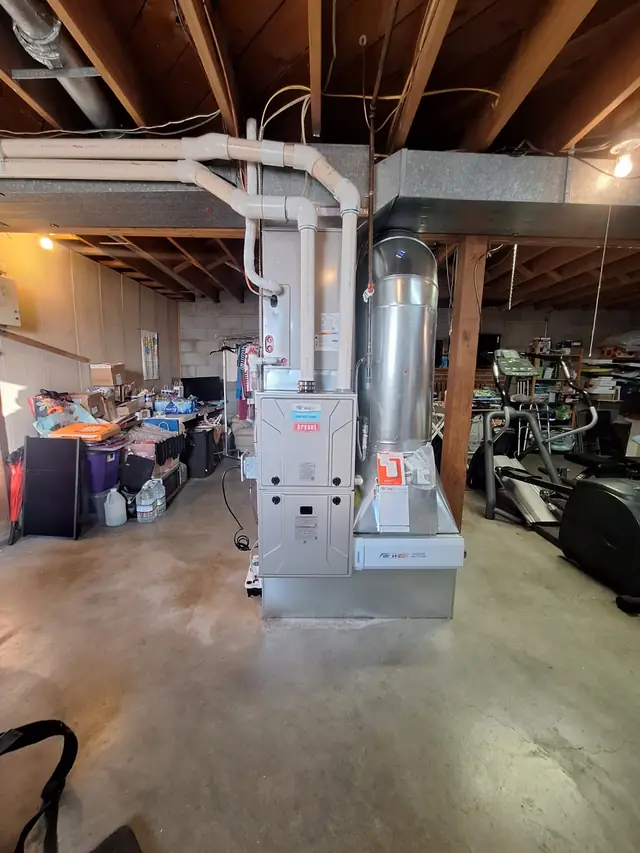
New furnace with fresh sheet-metal ductwork and flue in an unfinished basement
Finding the inefficiency before anyone sells you equipment
Farwest says it plainly on its own service page: the team is trained “to help identify system inefficiency and help you develop a plan to fix those problems,” whether the answer is a system repair or a duct modification. A Comfort Advisor walks the house, looks at which rooms complain and why, and gives you options. If the honest answer is a duct change, that is what you get told.
One Yakima homeowner, Susanna Y, tells that story in her Google review. Her upstairs flex room was “brutal” in summer, barely tolerable without a freestanding A/C running. Two other companies quoted a mini split at 16 to 25 thousand dollars. The Farwest advisor took her aside and said they could do a split, but that adding a hot air return at less than 10% of the cost would likely do the trick. She quotes herself: “And by golly he was right.” The room now feels almost the same as downstairs, and she has since moved her HVAC work on all her properties to Farwest.
The fixes themselves are the ordinary tools of duct work. A return added where a room had none. A new supply run to a room that sat too far from the plenum. A leaky or crushed run replaced or rebuilt. Dampers and airflow balanced so each room gets its share instead of the closest room taking it all. Farwest also lists system inefficiency upgrade financing among its options, so a larger duct project does not have to land in one payment. Where a duct fix will not be enough, a ductless mini split is the next conversation, and the Comfort Advisor will tell you which one your house needs.
Chapter 03
Filters, MERV and keeping the airflow you paid for
A duct fix only holds if the air can still get through the filter. A filter packed with dust chokes a system as surely as a crushed duct does, and the room you just fixed goes quiet again.
Filter size matters more than most people expect. The Comfort Club plan includes 1 inch and 2 inch filters, Comfort Club Plus the same, and Comfort Complete includes a 5 inch filter, a 4 inch filter or an Aprilaire filter. Thicker media filters hold more dust before they load up, which means steadier airflow between changes. Which one fits depends on the cabinet or slot your system was built around, and a technician on a maintenance visit can tell you.
MERV rating is the other half of the story. A higher MERV filter catches finer particles, but it also pushes back harder against the air trying to pass through, and a system that was not designed for it can lose airflow, run longer and strain the blower. Higher is not automatically better. The right filter is the finest one your system can breathe through comfortably, and that is a question for the person looking at your equipment. Duct work and filtration also overlap with the air you breathe at home, which is why we cover them side by side with indoor air quality.
Farwest, A Washington L&I licensed contractor. Call (509) 457-5346.